
INTRO
AV solutions for government offices in India have moved well beyond projectors and microphones. The right AV solutions for government offices determine how effectively institutions communicate internally, conduct video conferences with central ministries, and deliver official briefings to the public. The Smart Cities Mission, the Digital India programme, and the push for paperless governance across central and state departments have together created a substantial demand for integrated audio-visual infrastructure in government buildings, secretariats, legislative halls, district collectorates, and public-facing service centres. According to the PIB’s report on Smart Cities Mission achievements , all 100 Smart Cities have operational Integrated Command and Control Centres, each requiring large-format display walls, multi-source video switching, and distributed audio systems as core infrastructure. Government AV procurement in India is increasingly specification-driven and GeM-aligned, which means institutions that understand what to specify, and why, are better positioned to procure systems that perform over a 7 to 10 year operational life. This guide covers the AV infrastructure requirements for the most common government office environments in India, the specifications that matter, and what to confirm before raising a purchase order.
What AV Infrastructure Do Government Offices in India Actually Need?
Government office AV requirements vary significantly by the type of space. A district collectorate conference room has different needs from a state secretariat press briefing hall, and both differ from an Integrated Command and Control Centre.
Specifying the same AV system across all three is one of the most common procurement errors in government AV projects.
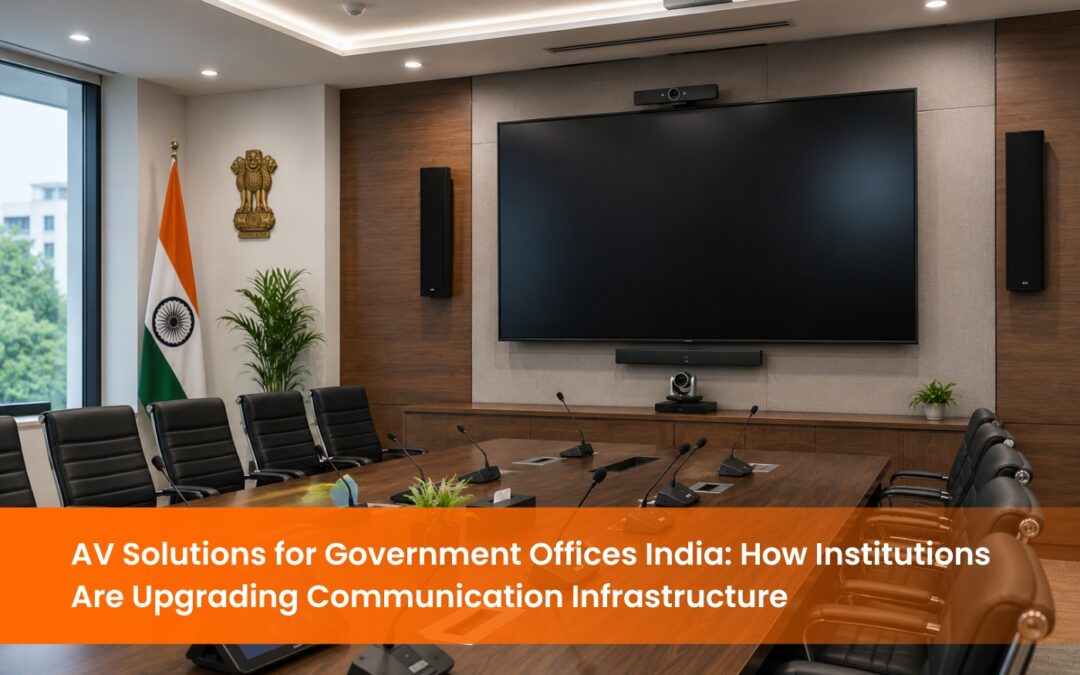
Conference rooms in government offices seat between 8 and 30 participants for inter-departmental meetings, video conferencing with central ministries, and briefings with external stakeholders. The core AV requirement for this environment is a large-format display (65 to 86 inches depending on room size), a PTZ video conferencing camera, a ceiling or tabletop conference microphone array, and a wireless presentation system that allows participants to share content from government-issued laptops without physical cables.
Press briefing halls and public communication spaces require a more broadcast-oriented AV setup. A podium with integrated audio, a large backdrop display for branding and content, multiple ceiling-mounted speakers for even audio distribution, and a recording system for archiving official communications are the standard specifications for these environments.
Integrated Command and Control Centres are the most technically complex government AV environment. They require LED video walls or large-format multi-display arrays for real-time data visualisation, video matrix switchers to route feeds from multiple sources to multiple displays simultaneously, and 24/7 rated display infrastructure.
Training and capacity building centres within government departments need AV solutions for government offices that mirror an educational AV ecosystem, covering interactive flat panel displays, digital podiums, and lecture capture systems applied to civil servant training, compliance workshops, and policy briefings.
How Does GeM Procurement Affect AV Solutions for Government Offices India?
The Government e-Marketplace (GeM) is the mandatory procurement platform for central government ministries, state government departments, public sector undertakings, and autonomous bodies in India. Any AV solutions for government offices purchased using government funds must be procured through GeM unless a specific exemption applies.
Understanding GeM procurement requirements before specifying AV equipment saves significant time and prevents situations where an institution specifies a system and then discovers the preferred supplier is not GeM registered, or the product is not listed on the portal.
GeM-listed AV products are categorised under specific product codes. Interactive flat panels fall under office equipment and IT hardware categories. PTZ cameras and video conferencing systems fall under ICT equipment. Audio systems and amplifiers are listed under electronics and electrical equipment. When writing an AV specification for a government project, the specification language should align with the GeM product taxonomy to ensure straightforward tendering.
For government projects above the GeM direct purchase threshold (currently Rs. 25,000 per product for direct purchase, with L1 competitive bidding required above Rs. 5 lakh), a detailed technical specification document is required. The specification should define minimum performance requirements such as brightness, resolution, connectivity, and operating hours rating, rather than brand names, which keeps the tender compliant with CVC guidelines on fair procurement.
EIS TechInfra Solutions is registered on the Government e-Marketplace and supplies AV products and systems to central and state government institutions across India through GeM-compliant procurement processes.
How Should Government Institutions Plan AV Solutions for Large Public Halls and Briefing Centres?
Large public halls, press briefing centres, and legislative committee rooms represent the highest-visibility AV solutions for government office environments in India. These spaces are recorded, broadcast, and archived, which makes AV system performance in these rooms a matter of institutional reputation.
The display infrastructure for a large government hall depends on the size of the space and whether the content being displayed is primarily document-based (presentations, legislative text) or multimedia (video feeds, data dashboards). For spaces up to 200 seats, a pair of large-format commercial displays positioned at both ends of the hall ensures visibility from all seating positions. For larger spaces and command centres, an LED video wall provides the brightness, seamless visual continuity, and scalability that individual displays cannot match.
The audio system for a government press briefing hall or public communication space requires distributed ceiling speakers to ensure even volume across all seating rows, a podium microphone system with wireless handheld backup for mobile presenters, and a recording output that archives the full audio feed for official records. In spaces where simultaneous interpretation is required for multilingual official proceedings, an interpreter console and receiver distribution system is an additional AV component that needs to be specified at the design stage.
Recording and archiving is a non-negotiable requirement for most formal government AV environments. Official proceedings, press briefings, committee meetings, and training sessions all generate archival content that departments are required to retain under government records management guidelines.
A lecture capture or recording unit integrated into the AV system captures screen content, camera feed, and audio simultaneously without requiring manual operation during the session.
Conclusion
AV solutions for government offices in India require a different procurement approach from corporate or educational deployments.
GeM compliance, long operational lifespans, 24/7 reliability requirements for control centres, and the formal communication standards of government environments all demand specification-led procurement rather than off-the-shelf purchasing. EIS TechInfra Solutions has been supplying and installing AV solutions for government offices across India since 2014, with GeM-registered products, end-to-end installation support, and AMC coverage. Explore ourAV solutions for government offices to find the right configuration for your institution.
FAQ
What AV solutions do government offices in India typically deploy?
Government offices in India deploy interactive flat panel displays, PTZ video conferencing cameras, conference audio systems, wireless presentation units, digital podiums for briefing halls, LED video walls for command centres, and recording systems for archiving official proceedings and training sessions.
What is the difference between a 16/7 and a 24/7 rated display for government use?
A 16/7 display is designed for 16 hours of daily operation and suits standard office conference rooms. A 24/7 display handles continuous around-the-clock operation and is the required specification for Integrated Command and Control Centres, public information displays in airports and railway stations, and other always-on government environments.
How does a PTZ camera improve government video conferencing?
A PTZ camera tracks the active speaker automatically, ensuring remote participants always see who is speaking regardless of where they are seated in the room. In government conference rooms where senior officials speak from different positions, a fixed webcam misses significant portions of the meeting. Auto-tracking cameras maintain professional broadcast quality throughout the session.
How long does an AV system installation take in a government office?
A standard conference room installation takes one to two days. A press briefing hall or large public space with distributed audio and a video wall takes three to five days. Multi-room rollouts across a secretariat or government campus are planned at four to six rooms per week depending on cabling infrastructure and room access schedules.
What after-sales support should government institutions require for AV installations?
Government AV specifications should include a minimum three-year warranty on all hardware components, an Annual Maintenance Contract with on-site response within 48 hours, remote monitoring capability for multi-room deployments, and confirmation that the supplier has local service technicians in the institution’s city. GeM registered suppliers with AMC listed on the portal can fulfil this requirement through a compliant procurement process.
Can AV equipment for government offices be procured through GeM in India?
Yes. Interactive displays, PTZ cameras, audio systems, and video conferencing equipment are all listed under relevant product categories on the Government e-Marketplace. Central ministries, state departments, and public sector undertakings are required to procure through GeM for government-funded purchases above the direct purchase threshold.
What is an Integrated Command and Control Centre and what AV does it need?
An ICCC is a centralised monitoring facility that aggregates data feeds from city infrastructure, traffic systems, utilities, and emergency services. AV requirements include an LED video wall or large multi-display array for data visualisation, a video matrix switcher to route feeds from multiple sources, and 24/7 rated display infrastructure for always-on operation.
What audio system is recommended for a government press briefing hall?
A distributed ceiling speaker system ensures even audio coverage across all seating rows. A podium microphone with wireless handheld backup covers both fixed-position and mobile presenters. For official government proceedings with simultaneous interpretation requirements, an interpreter console and audience receiver system is an additional specification needed at the design stage.
What is a wireless presentation system and why is it useful in government offices?
A wireless presentation system allows officials to share content from their laptops to the room display without physical HDMI cables. In IT-locked government computing environments where software installation is restricted, systems that require no driver installation are the appropriate specification. Participants connect via browser or hardware button and share their screen in under 30 seconds.