
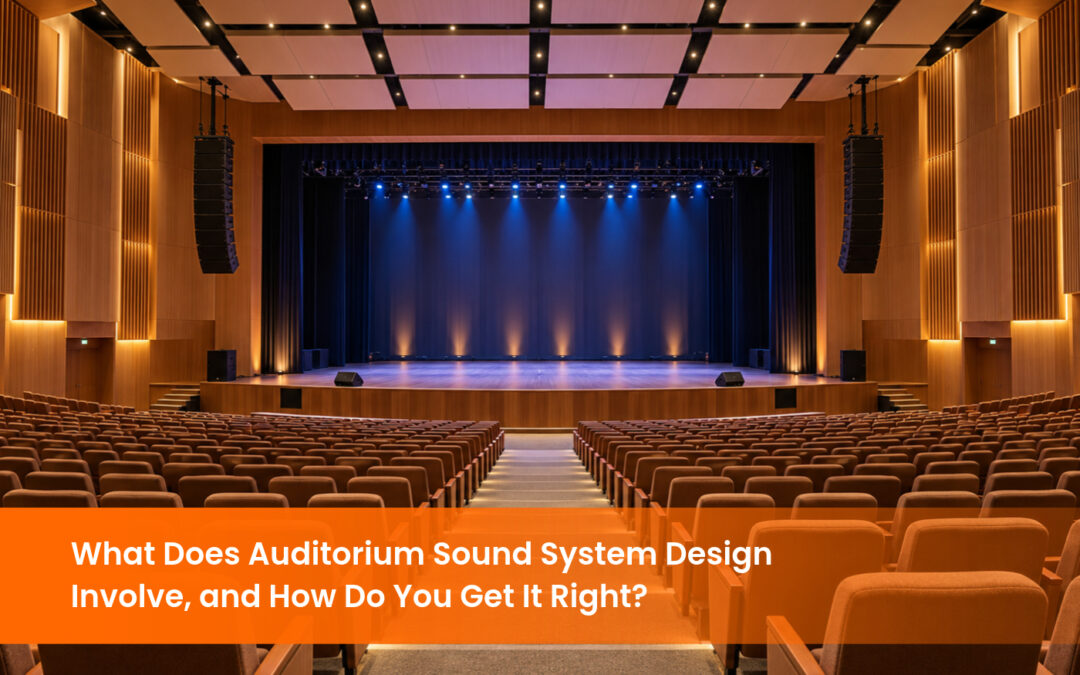
Auditorium sound system design is the process of measuring a hall’s acoustic condition, selecting and positioning speakers, specifying a signal processing chain, sizing amplification, and calibrating the complete system so that every seat receives speech and music at the same clarity and volume level. Schools, corporate campuses, government buildings, and cultural venues across India need professional auditorium sound system design because high ceilings, hard surfaces, and multi-use programs create acoustic conditions that standard audio equipment cannot address without engineering.
What professional auditorium sound system design covers:
- Acoustic measurement before any equipment is selected: RT60, the time sound takes to decay by 60 dB, is measured first and compared against the design target of 0.6 to 0.9 seconds for speech-first halls and 0.8 to 1.2 seconds for multipurpose halls before the speaker specification begins
- Speaker type matched to seat count and throw distance: Point source for halls under 300 seats, line array for larger venues, this is a calculation based on coverage geometry, not a preference or a budget decision
- DSP configuration for measurable speech clarity: The signal processor is tuned to achieve an STI score of 0.75 or above across all seating positions, the professional benchmark for good speech intelligibility on the IEC 60268-16 standard scale
- Amplifier sizing with headroom above rated power: Amplifiers running at 90 to 100% of rated output during long events compress audio and reduce speaker life, correct sizing leaves 3 to 6 dB of clean headroom above the highest expected operating level
- Post-installation calibration with measurement microphones: Frequency sweeps and in-seat listening tests at multiple positions confirm even SPL distribution before the hall is handed over for use
Why Is Auditorium Sound System Design Different From a Standard Room Setup?
Auditorium sound system design is a different discipline from standard room audio because the physical scale, reverberation characteristics, and multi-use requirements of a hall create problems that more speakers or more power alone cannot solve. These problems require acoustic modelling, coverage calculations, and engineering before installation begins.
- Reverberation time as the governing acoustic variable: RT60 determines whether speech is intelligible or muddy before a single speaker is switched on. For speech-first halls such as school assembly halls, lecture theatres, and corporate town hall venues, the target RT60 is 0.6 to 0.9 seconds. For multipurpose halls hosting both speech and music, 0.8 to 1.2 seconds is the acceptable range. A typical untreated Indian school auditorium with plaster walls, a tiled floor, and a high concrete ceiling has an RT60 of 2 to 3 seconds. At that level, words blur into echo before a sentence ends, and no amplifier or speaker upgrade corrects this. Only acoustic treatment does.
- STI as the measurable speech clarity benchmark: RT60 measures decay time. STI measures whether a listener can actually understand what is being said. Professional auditorium sound system design targets an STI score of 0.75 or above across all seating positions, which corresponds to good intelligibility on the IEC 60268-16 standard scale. An STI below 0.45 is the condition in most untreated Indian halls where a speaker system was installed without acoustic assessment. At that level, listeners strain to follow every third word regardless of how loud the system is.
- Balcony shadowing and the need for delay speakers: In halls with balconies or overhanging structures, the main speakers cannot reach seats under the overhang with direct sound. Those seats receive reflected sound first, arriving later than the direct sound from the stage, which produces a muddy echo effect. Delay speakers mounted at the balcony soffit edge, timed through the DSP to match the main system’s arrival, calculated as distance in meters divided by 343 meters per second, bring those seats into the coverage zone without adding echo.
- Multiple event types with conflicting acoustic requirements: A school auditorium hosts morning assemblies, drama performances, choir recitals, and board presentations in the same week. Each event type has different microphone configurations, different acceptable reverberation levels, and different feedback risk profiles. Professional auditorium sound system design accounts for all intended uses during the specification stage so the installed system handles every event type without manual reconfiguration between programs.
The acoustic analysis of the space is the foundation every subsequent equipment decision rests on, which is why design always begins with the room, not the product catalogue.
What Acoustic Treatment Does Auditorium Sound System Design Require?
Acoustic treatment is the first and most frequently skipped stage of auditorium sound system design. Skipping it means every equipment decision that follows is compensating for a room problem that treatment would have eliminated at lower cost and with better results.
- Absorption panels to bring RT60 within the target range: Fabric-wrapped acoustic panels, wall-mounted absorbers, and ceiling baffles absorb sound energy rather than reflecting it back into the hall. Placed on the rear wall, upper side walls, and the underside of balcony overhangs, absorptive materials bring RT60 toward the 0.6 to 1.2 second target range. The quantity and placement of absorbers is calculated from the hall’s measured volume and the gap between the existing RT60 and the design target, not estimated by appearance.
- Diffusion panels to distribute reflected energy evenly: Diffuser panels scatter reflected sound in multiple directions rather than returning it as a single concentrated reflection. Placed on rear walls and lower side walls, diffusers prevent flutter echoes, which are rapid repeating reflections between parallel hard surfaces that make speech difficult to follow from middle and rear seating positions. Diffusion works alongside absorption: absorption removes excess energy, and diffusion distributes what remains evenly across the listening area without making the room acoustically dead.
- Background noise floor control for HVAC and mechanical sources: An auditorium with a well-designed speaker system but a loud air conditioning unit has a background noise floor that competes directly with speech. Noise Criteria ratings, the standard measure of background mechanical noise in a room, should be below NC-35 in a professionally designed auditorium. Above that threshold, STI scores drop even when the speaker system is technically correct, because the noise floor raises the listener’s threshold of intelligibility across the entire frequency range.
- Acoustic modeling before construction or major renovation: In new-build auditoriums and significant renovations, acoustic treatment quantities and panel placement should be modelled in software before any material is ordered or installed. Modelling predicts the post-treatment RT60 and identifies problem reflection paths from the room geometry before they become fixed construction decisions. Correcting a reflection problem in software at the design stage costs nothing. Correcting it after the hall is built requires either additional treatment or a speaker system that works around a permanent acoustic fault.
With the room prepared acoustically, speaker selection becomes a geometry and coverage calculation rather than a product preference.
How Do You Select the Right Speakers for an Auditorium Sound System?
Speaker selection in auditorium sound system design is determined by the hall’s seat count, throw distance from the stage to the last row, and the presence of balconies or architectural features that create coverage shadows, not by budget preference or brand familiarity.
Speaker system by hall scale, industry reference:
| Hall Scale | Seat Count | Throw Distance | Recommended Speaker System |
|---|---|---|---|
| Small | Up to 150 | Under 12 m | Point source wall or ceiling speakers |
| Medium | 150 to 300 | 12 to 20 m | Point source main cluster with optional delays |
| Large | 300 to 600 | 20 to 35 m | Line array system with fills and delays |
| Very large | 600 and above | 35 m and above | Full line array with distributed delay system |
- Point source speakers for small and medium halls: A high-quality point source loudspeaker positioned at the front of the stage and angled to cover the full width of the seating area delivers even SPL from the front row to the back in halls up to 300 seats and throw distances up to 20 metres. The critical specification is the speaker’s dispersion pattern. Horizontal and vertical coverage angles must match the seating geometry precisely so sound reaches the last row without spilling onto the ceiling or side walls, which creates reflections that reduce speech intelligibility.
- Line array systems for large auditoriums: A vertical column of multiple speaker elements, a line array controls sound output vertically, keeping coverage within the seating area without losing energy to the ceiling or floor. This vertical control maintains even SPL from the front row to the final seat in halls above 300 seats, where a single point source cannot sustain coverage over the throw distance without raising the volume to a level that is uncomfortably loud in the front rows. Line arrays are the standard specification for halls above 300 seats and for any hall with a throw distance exceeding 20 metres.
- Delay speakers for balcony and overhang zones: Seats under a balcony overhang sit outside the main system’s coverage pattern. Compact loudspeakers mounted at the balcony soffit bring those seats into coverage. The DSP adds a delay to the signal going to these speakers equal to the time the main system’s sound takes to travel to that position from the stage, typically 30 to 80 milliseconds depending on hall dimensions. Without this timing, the delay speaker produces echo rather than reinforcement and STI scores in those seats drop sharply.
- Subwoofers for multipurpose and performance venues: Schools and corporate auditoriums hosting musical performances, dance recitals, or large-scale events need subwoofer support for the 60 to 120 Hz frequency range that full-range speakers cannot reproduce at adequate output levels. Subwoofers should be placed away from reflective rear walls and corner positions that cause low-frequency buildup. Multiple subwoofers distributed symmetrically across the front of the stage produce more even bass coverage across all seating positions than a single unit placed to one side.
Speaker placement creates the physical coverage pattern. The signal processing chain is what makes that coverage consistent and controllable across every event type the hall hosts.
What Signal Processing and Amplification Does an Auditorium Sound System Need?
Signal processing and amplification form the technical backbone of any auditorium sound system design. The acoustic treatment and speakers define the potential of the system, but the DSP and amplifiers determine whether that potential is realized at every event.
Complete auditorium signal chain:
- DSP equalization for room correction: A DSP applies targeted equalization cuts and boosts to correct the frequency response irregularities every room introduces. In a typical Indian school auditorium, the most common problems are a low-mid buildup at 200 to 400 Hz from parallel plaster walls, which makes speech sound chesty and unclear, and a brightness peak at 2 to 4 kHz from hard ceiling surfaces that makes high-pitched sounds harsh. Both are corrected using parametric equalization filters set during the calibration session after physical installation, not by ear during soundcheck.
- Feedback suppression for institutional microphone use: Automatic feedback suppression filters in the DSP identify the specific frequencies where feedback is about to occur and place narrow notch filters at those frequencies before the squeal becomes audible. This is the critical feature for school assemblies and corporate town halls where non-technical users hold microphones and move around the stage unpredictably. A system without DSP feedback suppression relies entirely on the microphone user’s technique, which is an unreliable variable in every institutional environment.
- Delay alignment for multi-speaker configurations: When a hall has main speakers and delay speakers under a balcony, the DSP adds a precise time delay to the signal going to the delay speakers so both systems arrive at the listener simultaneously. Without this alignment, the two speaker systems fight each other and the delay speaker produces echo rather than reinforcement, reducing STI scores in the affected seating rows rather than improving them.
- Amplifier specification within the signal chain: EIS TechInfra’s professional audio range includes Yamaha PX series power amplifiers for auditorium main cluster and fill systems where reliable Class D output and consistent protection circuits are required across long operational days. The Yamaha MA series handles multi-zone auditorium installations where the main hall, stage monitor feeds, and overflow room speakers need independent amplifier channels from one rack unit without a separate external DSP. For a detailed breakdown of how amplifier zones are planned across different building types, read the EIS TechInfra guide to multi-channel amplifiers for offices and campuses.
What Factors Determine Auditorium Sound System Price in India?
Auditorium sound system price in India varies based on hall size, acoustic condition, speaker technology, and signal chain complexity. Any figure quoted without a site survey is unreliable, and institutions that budget for equipment alone without accounting for acoustic treatment and calibration consistently face cost overruns after installation begins.
- Hall size and seat count as the primary cost driver: A small hall of 80 to 150 seats with point source speakers, a basic DSP, a two-channel amplifier, and a two-microphone wireless system sits at a fundamentally different investment level from a 500-seat multipurpose hall requiring line array speakers, a multi-channel DSP, multiple amplifier channels, subwoofers, stage monitors, and a full wireless microphone system. The seat count determines the speaker quantity, amplifier channel count, and cable run length, all of which compound to produce the final project cost.
- Acoustic treatment as the most underestimated budget item: Acoustic panels, ceiling baffles, and diffuser materials are frequently excluded from the initial AV budget because facility teams treat them as a construction cost rather than an audio cost. In practice, a hall that requires significant RT60 correction needs acoustic treatment specified and installed before any audio equipment is commissioned. In heavily reverberant spaces, the treatment cost can equal or exceed the equipment cost, and omitting it means the installed audio system will never achieve its specified STI targets regardless of equipment quality.
- Equipment grade and its impact on total cost of ownership: Entry-level commercial audio equipment produces acceptable results in controlled environments. Professional-grade equipment, with higher SPL capability, tighter dispersion control, and longer service life, costs more upfront but costs less across a 10-year operational horizon when maintenance frequency and component replacement are factored into the calculation. The correct grade depends on the hall’s use intensity and how the institution calculates total cost of ownership versus initial capital expenditure.
- Installation, calibration, and commissioning as non-negotiable cost components: Equipment cost is only part of the total auditorium sound system price. Professional installation, covering correct cable routing, rack build, DSP programming, acoustic measurement, and STI verification at multiple seat positions, is the stage that determines whether the equipment performs as specified. Institutions that accept low installation quotes without calibration inherit a system that technically operates but does not perform to the level the equipment is capable of delivering.
Contact EIS TechInfra through einfratech.com/contact for a site assessment. The team produces a detailed project specification with itemized costs before any procurement commitment is made.
What Does Small Auditorium Sound System Design Involve Specifically?
Small auditorium sound system design, for halls under 150 seats, follows the same acoustic principles as larger hall design but differs in equipment scale, processing complexity, and total project scope. It is a distinct specification process rather than a simplified version of large hall work.
- Acoustic treatment scaled to smaller room volumes: A small hall of 80 to 150 seats typically has a room volume of 600 to 1,500 cubic meters. Bringing RT60 to the 0.6 to 0.9 second target in this volume usually requires acoustic panels on the rear wall and ceiling baffles above the seating area, which is a smaller total treatment area than a large hall requires. The acoustic principles and measurement process remain identical regardless of hall size. Only the quantities and surface coverage differ.
- Point source ceiling or wall speakers as the standard specification: In a small auditorium with a throw distance under 12 meters, high-quality point source speakers mounted on side walls or positioned at the front of the stage provide even coverage to all seating positions. The key specification is selecting a speaker with a dispersion pattern that fills the seating area without creating strong rear-wall reflections. A pattern that is too wide sends energy onto the rear wall and reduces speech intelligibility in the front rows.
- Simplified DSP requirements without reduced calibration: A small hall typically needs a 2 to 4-channel DSP with equalization, feedback suppression, and one or two delay channels for any under-balcony fills. The configuration is simpler than a large hall system, but the calibration process, covering measurement microphone frequency sweeps and STI verification at multiple seat positions are identical and cannot be skipped regardless of hall size or project budget.
- Wireless microphone coordination in congested urban spectrum: A small auditorium used for speeches, assemblies, and performances needs at minimum one wireless handheld microphone and one wireless lavalier or headband for performers. In urban Indian environments, the wireless spectrum is congested with broadcast signals, mobile data, and neighboring AV systems. Frequency coordination, which involves identifying and assigning clear wireless channels that avoid interference, is a required specification step for every multi-microphone system, even a two-unit setup in a small school hall.
How Do You Maintain an Auditorium Sound System After Installation?
A professionally maintained auditorium sound system performs reliably for 10 to 15 years in institutional use. The majority of system failures during important events trace back to deferred maintenance tasks, not component faults.
- Pre-event checklist before every significant program: Before every speech day, cultural event, or large corporate presentation, a responsible person should power the full system, test each microphone on its intended use position, replace wireless microphone batteries regardless of remaining charge, and confirm all speaker zones are active. A five-minute pre-event check catches the issues that surface during opening addresses. Dead batteries, disconnected cables, and accidentally adjusted volume presets account for the majority of event-day audio failures in Indian institutional settings.
- Bi-annual cable and connection inspection: Every six months, a qualified technician inspects all speaker cable terminations, microphone connector pins, DSP input and output connectors, and amplifier binding posts for corrosion, looseness, and physical damage. In Indian institutional environments, humidity during monsoon season and temperature cycles between summer and winter accelerate connector oxidation faster than in air-conditioned commercial settings. A loose speaker terminal causes intermittent channel dropout, which is the fault most commonly reported by school staff as a speaker that stopped working during a program.
- Annual STI remeasurement and DSP recalibration: Auditoriums change acoustically over time as seating fabric changes, new curtains are added, ceiling panels are repainted, or furniture is introduced into the space. An annual remeasurement session with a calibrated microphone confirms that STI scores remain at 0.75 or above at all seat positions and that DSP settings have not been adjusted away from their calibrated values by non-technical staff. Without recalibration, intelligibility degrades gradually without any single identifiable cause.
- DSP configuration backup after every change: Every DSP parameter, covering equalization curves, delay values, feedback filter positions, gain limits, and preset configurations, must be exported to an external file after commissioning and after every subsequent adjustment. A processor replacement or firmware update without a current backup file requires the entire system to be remeasured and recalibrated from scratch, which is a full working day that a five-minute configuration export eliminates entirely.
EIS TechInfra Solutions is a leading AV distributor in Bangalore, serving schools, corporate campuses, government facilities, and cultural institutions across India since 2014. The team designs and delivers complete auditorium sound system projects, from initial acoustic measurement and room treatment specification through speaker coverage modelling, DSP configuration, Yamaha PX and MA series amplifier selection, installation, calibration, and annual maintenance.
EIS TechInfra’s professional audio range covers the full signal chain required for auditorium sound system design at every scale. The AV services team manages every stage from site survey to handover. Contact EIS TechInfra for an on-site acoustic assessment and a complete system specification built around your hall’s dimensions, seat count, and programme requirements.
FAQ
1. What is auditorium sound system design, and why does it need professional engineering rather than standard installation?
3. What is the difference between small auditorium sound system design and large hall design?
5. How do I get auditorium sound system design services for a school, college, or institution in Bangalore?
7. Can an existing auditorium sound system be upgraded without replacing everything?
9. How does an auditorium sound system support live streaming or recording of events?
2. What RT60 and STI targets should a professionally designed auditorium achieve?
4. What equipment does a complete auditorium sound system typically require?
6. Does an auditorium sound system need to comply with any Indian safety or building standards?
8. What is the impact of seating material and audience occupancy on auditorium acoustics?
10. What qualifications should an AV integrator have before being entrusted with auditorium sound system design?

Follow Us

Head Office Address
#311, 60ft Road, Thalakaveri Layout, Amruthahalli Main Road, Sahakara Nagar Post, Bengaluru-560092

Copyright ©2024 EIS TechInfra Solutions, All Rights Reserved. Designed by Fablesquare