
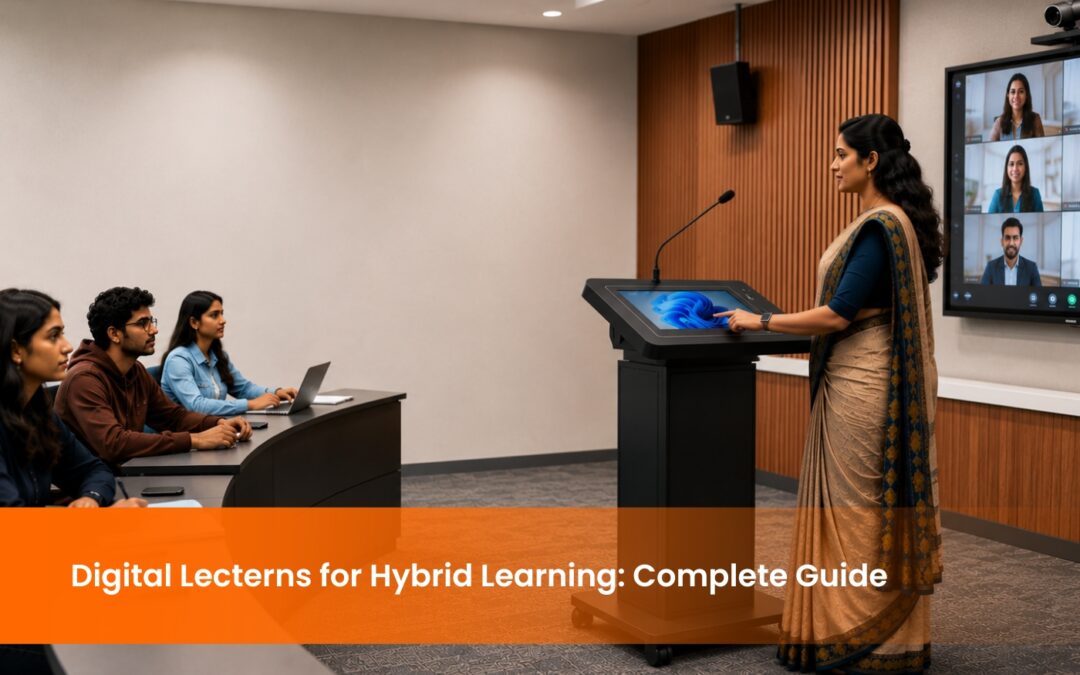
How Digital Lecterns Are Powering Hybrid Learning in 2025
What Exactly Are Digital Lecterns?
Let’s start with the basics. Digital lecterns might look like regular podiums at first glance, but they’re anything but ordinary. These sleek devices are packed with technology—think touchscreen displays, built-in microphones, and connections for just about every gadget you can imagine. They give educators the power to control presentations, interact with students, and even broadcast lessons online, all from a single spot.
Why Digital Lecterns Matter in Hybrid Learning
If you’ve ever tried to teach a class with half the students in front of you and the other half online, you know how tricky it can get. Without the right tools, keeping everyone engaged feels almost impossible. This is where digital lecterns shine.
Picture this: a history professor giving a lecture on World War II. With a digital lectern, she can display maps for her in-person students while simultaneously sharing those visuals with remote learners via a livestream. Everyone stays on the same page, literally and figuratively.
Digital Lecterns in Action: A Real Classroom Deployment
How Digital Lecterns Enhance the Learning Experience
They Simplify Complex Setups
They Make Learning More Inclusive
Inclusion is the cornerstone of hybrid education, and digital lecterns deliver on this promise. They offer tools like live captions for students with hearing impairments, translation options for multilingual classrooms, and recording features for those who can’t attend in real-time.
They Foster Collaboration
With features like screen sharing and real-time polling, digital lecterns make collaboration easy—even in hybrid settings. Imagine a biology teacher leading a hybrid lab session. In-person students work on microscopes, while online participants analyze the same samples through a high-definition video feed shared via the lectern. Everyone contributes, and no one feels left out.
The Shift to Hybrid Learning: A Permanent Change
If the pandemic taught us anything, it’s that hybrid learning isn’t going anywhere. Even as classrooms reopen, many students and educators prefer the flexibility of hybrid models. This makes tools like digital lecterns indispensable—not just for now but for the foreseeable future.
What Should You Look for When Buying Digital Lecterns?
Connectivity is where many buyers underestimate their needs. A classroom digital lectern should carry at minimum two HDMI ports, four USB ports, a LAN connection, and Wi-Fi. The HDMI outputs connect to the room display and the recording system independently. A built-in gooseneck microphone handles presenter audio, but the unit should also support a wireless handheld microphone for faculty who move around during lectures.
Recording capability at 1080p and 60 frames per second is the current baseline for lecture capture that plays back clearly on student devices. Anything below this produces video that looks acceptable in the recording app but pixelates on a laptop screen at full width.
Features That Make Digital Lecterns Stand Out
Are Digital Lecterns the Right Fit for Indian Universities?
IITs and IIMs adopted digital lecterns early, primarily for executive education programmes where remote participants pay premium fees and expect broadcast-quality delivery. Private medical colleges followed, driven by the need to maintain teaching continuity during clinical rotation schedules that keep students spread across campuses. State universities are now the active adoption frontier, supported by central government funding under the Samagra Shiksha scheme for digital classroom infrastructure.
For Indian institutions specifically, two factors matter beyond the standard specification checklist. Voltage stabilisation is non-negotiable because power fluctuations in Tier 2 and Tier 3 cities regularly damage unprotected electronics. Local service support is equally critical because a digital lectern that fails mid-semester needs a technician on-site within 48 hours.
Practical Challenges and How to Overcome Them
Of course, no tool is perfect. Digital lecterns can be pricey and adopting them requires training. However, many schools are finding creative solutions, like applying for grants or starting small with basic models. It’s an investment, but one that pays off quickly in terms of engagement and efficiency.
The Future of Digital Lecterns in Education
As technology evolves, so do digital lecterns. Think about features like AI that could analyze student engagement during a lesson or augmented reality overlays that bring content to life. These aren’t just wishful ideas—they’re the next logical step in the evolution of hybrid classrooms.
Conclusion
FAQ
What are digital lecterns and how do they work in a classroom?
How do digital lecterns support hybrid learning for remote students?
Do digital lecterns support accessibility for students with hearing impairments?
What is the installation process for digital lecterns in a university classroom?
How do Indian universities fund digital lectern procurement?
What specifications should a university check before buying digital lecterns?
Are digital lecterns compatible with existing classroom AV systems?
How long do digital lecterns typically last in an institutional setting?
Can digital lecterns be used for examinations and assessments?
What after-sales support should institutions ask for when buying digital lecterns?
Stay updated with the latest news, insights, and exclusive content by following us.