
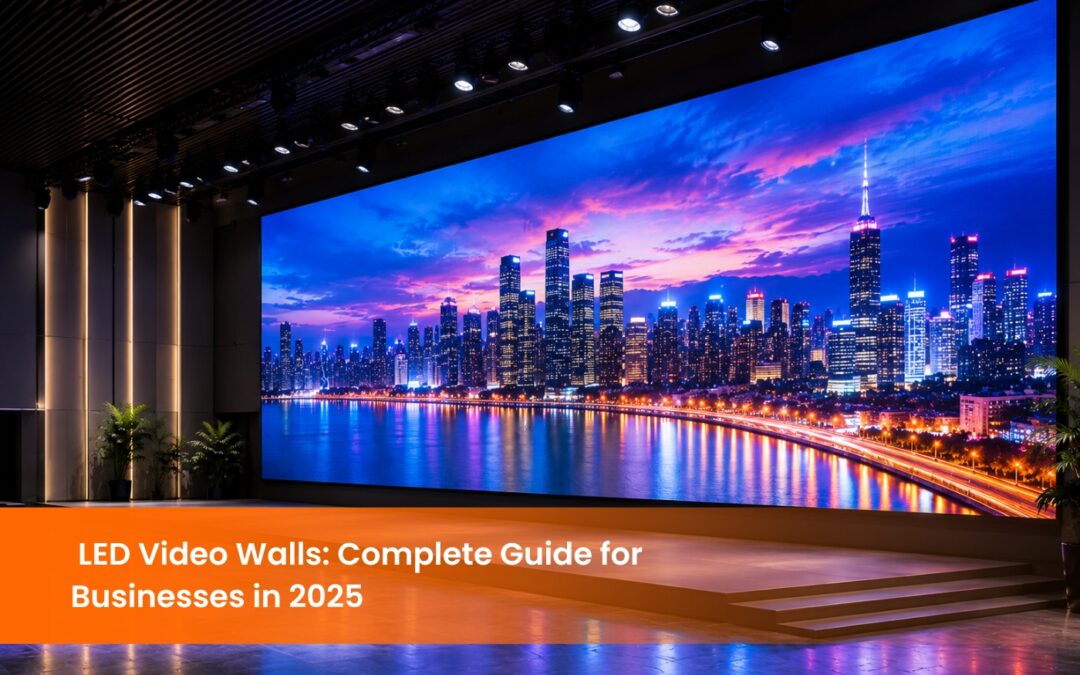
LED Video Walls: The Complete 2025 Guide for Businesses and Institutions
Control rooms in Indian government agencies, retail flagships in Mumbai and Delhi, and auditoriums across the country are all moving to LED video walls because the combination of brightness, scalability, and zero maintenance downtime makes every other display option look like a compromise. This guide covers what LED video walls are, how to choose the right pixel pitch, where they perform best, and what separates a good installation from one that underdelivers.
What is an LED Video Wall?
A single installation can span 3 metres or 30 metres depending on the number of panels configured. The result is a display that maintains consistent brightness and colour accuracy at any size, in any lighting condition, with no visible screen borders breaking up the image. EIS TechInfra supplies LED video walls in both the LC Cabinet format for fixed installations and the AIO All-In-One format for spaces that need integrated processing and a cleaner cable setup.
What Is Pixel Pitch and Why Does It Determine Which LED Video Walls You Need?
Getting pixel pitch wrong is one of the most expensive mistakes in LED video wall procurement. A P1.2 panel installed in a large auditorium where the closest viewer sits 10 metres away wastes significant budget on resolution the audience cannot perceive. A P3.9 panel installed in a control room where operators sit 2 metres from the screen produces a display that looks pixelated in daily use.
Pixel Pitch
Minimum Viewing Distance
Typical Use Case
Key Features of the D Series LED Video Wall
The D Series All-In-One LED Video Wall stands out for its impressive features, making it a reliable and efficient choice for any professional or commercial environment. Let’s understand what makes LED Video Walls superior:
High-Definition Resolution for Clear, Crisp Content
User-Friendly Operation
The D Series LED video wall is easy to use. Users can seamlessly switch between different content sources and split the screen into multiple views with an intuitive interface and built-in video processing. This makes it easy to manage complex presentations or display different types of content simultaneously.
Built-In Audio System
For a complete audiovisual experience, the D Series LED wall has a built-in high-quality audio system. Tuned by professional sound engineers, this system ensures precise sound that complements the stunning visuals. The 2 x 30W speakers with 90DB sensitivity provide ample sound for mid-sized venues, eliminating the need for external speakers in many cases.
Auto Brightness and Adaptive Display
The D Series is designed to adapt to its environment, with an auto-brightness feature that adjusts based on the lighting conditions of the room. This ensures optimal visibility and reduces eye strain for viewers, making it perfect for various lighting environments. Whether you’re presenting in a brightly lit room or a darkened theater, your content will always appear vibrant and clear.
Slim, Aesthetically Pleasing Design
The design of the D Series LED video wall is functional and highly aesthetically pleasing. With ultra-thin bezels and a sleek form factor, these video walls are as much a piece of art as a piece of technology. The slim design means that the LED video wall fits seamlessly into any space, whether it’s an office, a retail store, or an exhibition hall.
Where Do LED Video Walls Perform Best?
In corporate boardrooms and executive briefing centres, LED video walls replace the single large display that cannot cover a wide enough field of view for a long conference table. A 4 by 2 metre configuration gives every seat in a 20-person boardroom an unobstructed view of the content without requiring attendees at the ends of the table to turn at an angle.
In retail environments, LED video walls serve as dynamic facades that change content by time of day, product campaign, or customer interaction trigger. A retail flagship in a high-footfall location uses the display as a brand statement and a content delivery system simultaneously. The brightness levels achievable with LED video walls, typically between 800 and 5000 nits depending on the panel, ensure that even in a brightly lit shop floor, the display commands attention.
In control rooms for utilities, traffic management, and security operations, LED video walls provide the large-format, always-on display surface that operators need to monitor multiple data feeds simultaneously. The 100,000-hour rated lifespan of LED panels makes them suitable for 24-hour operational environments where a display failure creates a genuine operational risk.
In event and conference venues, LED video walls function as stage backdrops, presenter support displays, and audience engagement tools within the same installation. The modular nature of LED panels means the same set of panels can be reconfigured for different stage layouts across different events.
Why Choose LED Video Walls for Your Business or Event?
Scalability is the second. No other display technology scales from a 2-metre installation to a 20-metre installation using the same panel components. LED video walls grow with the space and the requirement rather than requiring a full replacement when needs change.
Scaling a wall is a controller decision as much as a panel decision. Our videowall solutions pair the display modules with the processing needed to drive them, so adding a row later does not mean replacing the source equipment.
Viewing quality is the third. LED video walls produce brightness levels that LCD panels and projectors cannot match in ambient light conditions. In a well-lit retail environment or a conference hall with windows, an LED video wall maintains full visual impact where other display technologies wash out.
Energy efficiency is fourth. LED video walls consume significantly less power per square metre of display area than equivalent projection setups and have no consumable components to replace. The 100,000-hour rated panel lifespan translates to over 11 years of continuous operation before brightness falls below the standard replacement threshold.
How Do LED Video Walls Compare to LCD Video Walls?
Factor
LED Video Walls
LCD Video Walls
Are LED Video Walls Suitable for Both Indoor and Outdoor Use in India?
Indoor LED video walls operate at brightness levels between 800 and 1,500 nits. At these levels, the display is clear in standard indoor lighting but would be invisible in direct sunlight. Indoor panels carry an IP30 rating, which provides basic dust protection adequate for a climate-controlled environment. The D Series AIO from EIS operates at this specification and is designed specifically for controlled indoor environments including boardrooms, auditoriums, lobbies, and retail interiors.
Outdoor LED video walls require a minimum brightness of 5,000 nits to remain visible in direct sunlight. They carry an IP65 rating, which provides full dust protection and resistance to water jets, making them suitable for exposed outdoor locations. Outdoor panels also require UV-resistant coatings and wider operating temperature tolerances to function through Indian summer conditions where ambient temperatures regularly exceed 40 degrees Celsius.
For semi-outdoor environments such as covered malls, airport atriums, and metro station concourses, a high-brightness indoor panel at 2,500 to 3,500 nits with an IP54 rating is typically the appropriate specification.
Additional Specifications of the D Series LED Video Wall
To provide a better understanding of the D Series LED video wall, here are some additional technical specifications:
- Color Temperature: It is Adjustable at 6500K for multiple models.
- HDMI Inputs: 3 x HDMI 2.0 for all models, ensuring compatibility with various devices.
- Operating Temperature: It can function in multiple temperature ranges from -10°C to +40°C, making it adaptable to various environments.
- IP Rating: IP30 offers protection against dust and environmental factors.
- Lifetime: It lasts for an entire 100,000 hours, ensuring long-term reliability.
Connect with EIS Techinfra Solutions today for advanced AV solutions and comprehensive services tailored to your needs!
Conclusion
Stay updated with the latest news, insights, and exclusive content by following us.