
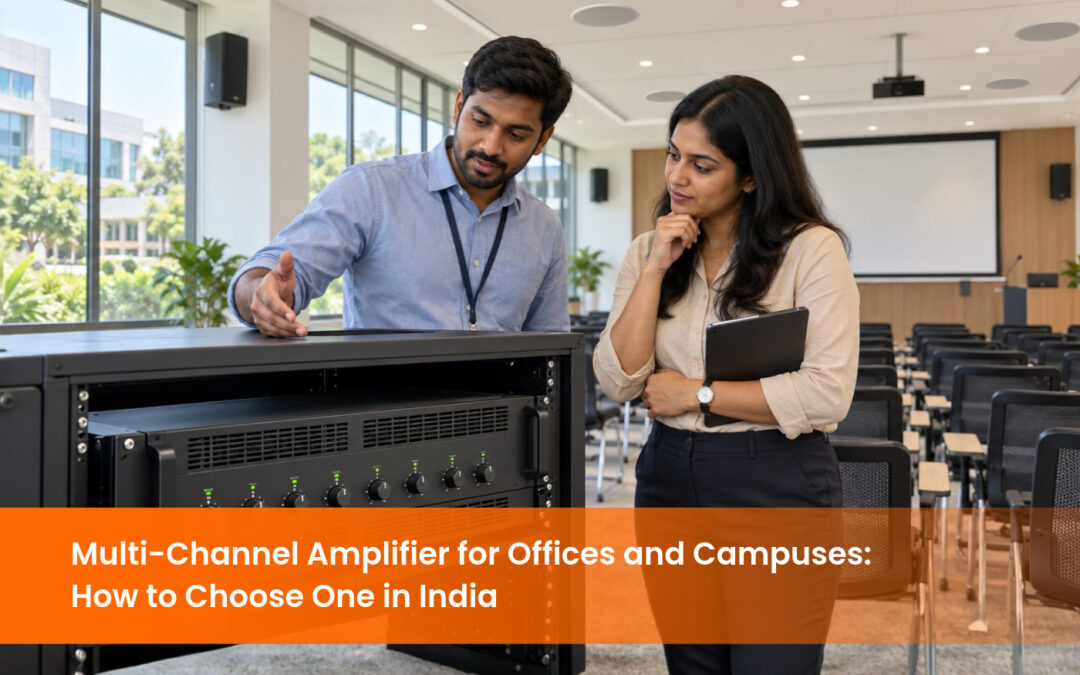
A multi-channel amplifier is a professional audio device that powers multiple independent speaker zones from one rack-mounted chassis, with each zone receiving its own source, volume level, and output control independently of every other zone in the building. Corporate offices, school campuses, government buildings, and commercial venues in India use a multi-channel amplifier to replace several single-zone units with one organized, rack-mounted system that a technician installs, configures, and services from a single location.
What a multi-channel amplifier delivers:
- Independent zone control from one chassis: Each zone connects to dedicated amplifier channels and runs on its own source and volume. Adjusting the boardroom has no effect on the lobby, cafeteria, or training room running simultaneously.
- Low-impedance or 70V/100V operation by cable run distance: Low-impedance suits short runs under 50 meters in single buildings. 70V/100V constant-voltage distributes audio cleanly across cable runs over 100 meters without power loss.
- Class D efficiency for 10- to 12-hour institutional operating days: Converts 80 to 90% of drawn power into audio output, runs cool without forced rack cooling, and does not shut down thermally during full-day school programs or corporate conferences.
- Shared bus inputs for building-wide broadcasts: One PA announcement or background music source routes to all zones simultaneously through bus inputs without additional switching hardware or rewiring.
- Bridge mode for high-power single zones: Two channels combine to double the output for one large zone, such as an auditorium, an atrium, or an open-plan floor, without adding a separate high-power amplifier to the rack.
What Is a Multi-Channel Amplifier and How Does It Work?
A multi-channel amplifier takes audio signals from one or more sources, amplifies each through independent output channels, and delivers speaker-driving power to multiple zones simultaneously, all from one chassis that a technician installs, configures, and services from a single rack location.
- Independent channel architecture for fault isolation: Each output channel operates on its own signal path with its own gain control and protection circuit. When a fault occurs on one channel, such as a shorted speaker cable or an overloaded zone, the protection circuit isolates that channel without interrupting the remaining zones. In a school where one classroom speaker cable develops a fault, the assembly hall, corridors, and other classrooms continue broadcasting while the fault is traced and corrected.
- Class D amplification for commercial duty cycles: Class D amplifiers switch output transistors on and off at high frequency, typically 300 to 500 kHz, and filter the result into an analog audio signal. This approach converts 80 to 90% of input power into output, compared to 50 to 65% in a Class AB design. The practical result is an amplifier that runs cool during a 10-hour school day or a full-day corporate conference without thermal shutdown, forced cooling, or ventilation gaps that consume additional rack space.
- Bus inputs for simultaneous zone coverage: Most professional multi-channel amplifiers include two shared bus inputs alongside the dedicated zone line inputs. These bus inputs carry one source, such as a PA microphone, a fire alarm audio feed, or a background music player, to all zones simultaneously at a configurable priority level. In a corporate campus, the facilities team broadcasts a building-wide announcement from one microphone position without touching individual zone controls or additional switching hardware.
- Protection circuits for unattended rack operation: Short-circuit protection, overcurrent limiting, and thermal protection are standard on professional multi-channel amplifiers. When a fault condition occurs, the relevant channel engages protection mode and a front-panel status LED identifies the affected zone, allowing a technician to identify and correct the fault during a scheduled inspection rather than during an event.
Understanding how the amplifier functions internally leads to the most fundamental specification decision. Low-impedance or 70V/100V wiring determines the entire system architecture before a single cable is purchased.
What Is the Difference Between Low-Impedance and 70V/100V Multi-Channel Amplifiers?
The choice between low-impedance and 70V/100V constant-voltage wiring is the single most important decision in any commercial multi-channel amplifier specification. It determines speaker selection, cable specification, and total installed cost before any product is ordered.
| Factor | Low-Impedance (4 to 8 Ohms) | 70V / 100V Constant Voltage |
|---|---|---|
| Suited to | Cable runs under 50 m. | The cable runs over 50 m. |
| Typical speaker count per zone | 2 to 8 speakers | 20 to 50 or more speakers |
| Cable gauge requirement | Heavy gauge, power loss increases with distance. | Standard gauge, voltage stays constant over distance |
| Speaker type | Standard passive speakers | Transformer-tapped speakers |
| Per-speaker volume control | Via zone amplifier channel only | Adjustable at each speaker via transformer tap |
| Typical Indian application | Corporate meeting rooms, boutique offices, small schools | School campuses, government complexes, malls, hospitals |
- Low-impedance for contained single-building installations: A corporate office where the AV rack and all speaker zones sit within 30 to 40 meters of each other uses low-impedance wiring with standard 4- to 8-ohm passive speakers. The amplifier drives the speaker load directly, cable resistance at short distances does not cause measurable power loss, and standard passive speakers cost less per unit than constant-voltage alternatives. This is the correct architecture for a mid-size office with four to six meeting rooms, a reception area, and a cafeteria.
- 70V/100V for large campus and multi-building installations: A school campus where speakers cover classrooms across three buildings separated by 100 to 200 meters of cable requires constant-voltage distribution. The amplifier outputs at 70V or 100V line level; each speaker taps that voltage through a built-in transformer at a selected power tap, typically 1W, 2W, 4W, or 8W, and the voltage remains constant regardless of how many speakers connect or how long the cable run extends. Power loss over long distances, the primary technical problem with low-impedance wiring at scale, does not occur.
- Hybrid systems for mixed-use institutional buildings: Many Indian institutional buildings require both topologies. The main auditorium and boardroom need low-impedance wiring for higher fidelity and greater power per speaker. Corridors, classrooms, and outdoor areas need 70V/100V distribution for practical cable management across long runs. A multi-channel amplifier with per-channel impedance selection handles both from one unit, with low-Z channels assigned to high-fidelity zones and constant-voltage channels serving the distributed system.
What Is the Difference Between a Multi-Channel Amplifier and a Multi-Zone Amplifier?
Multi-channel amplifiers and multi-zone amplifiers appear interchangeably in product listings and AV catalogues, but they describe different things. Confusing the two leads to a specification that does not match the facility’s actual operational requirement.
- Multi-channel describes the hardware output count: A multi-channel amplifier has more than two output channels. An 8-channel amplifier has eight independent outputs. Those channels can be assigned as four stereo pairs, eight independent mono zones, or any combination. The channel count is a hardware specification, not a system architecture statement.
- Multi-zone describes independent area control: A multi-zone system assigns each area, such as a room, a floor, or a building wing, to one or more amplifier channels with independent source selection, volume control, and scheduling per zone. A 4-zone amplifier pairs two channels per zone as a stereo pair, with one dedicated line input per zone and independent level control accessible from the front panel or a wall controller.
- The procurement distinction that matters: An 8-channel amplifier is not automatically a 4-zone system. Zone control requires dedicated inputs per zone, zone-level front panel or remote controls, and bus input routing capability. When specifying a multi-channel amplifier for a school or corporate campus, confirm that the unit provides zone-level control and not just multiple output channels at the amplifier stage. Otherwise the facility manager cannot adjust individual areas without accessing the rack directly.
- When each distinction matters most: A corporate building with four rooms needing different audio sources simultaneously needs a 4-zone multi-channel amplifier with dedicated zone inputs and wall panel outputs. A school campus where 20 classrooms need the same announcement simultaneously but at different volume levels needs a multi-channel amplifier with 70V/100V outputs and per-speaker transformer taps. The use case defines which architecture is correct. The physical amplifier hardware may be identical, but the configuration and cabling differ fundamentally.
How Do You Plan Zones for a Multi-Channel Amplifier Installation?
Zone planning translates the facility’s operational requirements into the correct amplifier specification. Done before procurement, it prevents under-specification that forces a second hardware purchase during installation.
Zone planning reference for typical Indian commercial and institutional buildings:
| Building Type | Typical Zone Count | Recommended Channel Count | Wiring Topology |
|---|---|---|---|
| Small office, under 50 staff | 2 to 3 | 4-channel | Low-impedance |
| Mid-size corporate office | 4 to 6 | 8-channel | Low-impedance |
| Large corporate campus | 6 to 10 | 8-channel plus second unit | Low-Z main, 70V corridors |
| School, single building | 4 to 6 | 8-channel | Low-impedance or hybrid |
| School, multi-building campus | 10 to 20 | 70V/100V system | Constant voltage throughout |
| Government office complex | 4 to 8 | 8-channel | Low-impedance or hybrid |
| Mall or retail complex | 8 to 16 | 70V/100V system | Constant voltage throughout |
- Count every independent area before specifying channels: Every area needing its own volume or source control is one zone. A facility with six independent zones needs at minimum a 6-zone amplifier. Specifying a 4-zone unit because it sits within an initial budget requires purchasing a second unit when the remaining zones are connected, costing more in total than the correct specification from the beginning.
- Build in 20% spare channel capacity for expansion: A school with four teaching buildings today will likely add a fifth within three to five years. An 8-channel amplifier specified for a current 6-zone requirement leaves two spare channels for expansion without additional hardware. A 6-channel unit specified to the exact current count forces a hardware purchase at expansion time regardless of budget conditions at that point.
- Confirm bus inputs sit outside the zone count: The two shared bus inputs on most multi-channel amplifiers carry sources that feed all zones simultaneously. They are not additional zones. A facility with four independent zones and one shared PA source needs a 4-zone amplifier with bus inputs, not a 5-zone unit. Miscounting bus inputs as zones leads to an over-specified purchase or an under-specified one when the buyer subtracts them incorrectly.
For institutions that need audio across a main auditorium as well as distributed zones, read the EIS TechInfra guide to auditorium sound system design for the speaker and DSP specification that sits upstream of the amplifier.
Which Multi-Channel Amplifiers Does EIS TechInfra Supply and Which Suits Your Project?
EIS TechInfra’s professional audio range includes the Yamaha PX series and Yamaha MA series amplifiers, both professional-grade units suited to Indian institutional and commercial distributed audio installations with different power output and configuration requirements.
- Yamaha MA series for multi-zone commercial installations: The MA series provides multi-channel output in a compact rack-mount chassis with built-in DSP, onboard EQ, and delay processing per channel. It suits corporate offices, mid-size schools, and government buildings where 4 to 8 zones of reliable, clean audio are required from a central rack without external DSP hardware. The MA series integrates directly with Yamaha MG series mixing desks for installations where live microphone mixing and distributed audio run from the same signal chain, and with Yamaha YVC unified communications speakerphones for meeting-room environments.
- Yamaha PX series for higher-power and larger installations: The PX series delivers higher output power per channel in a 2RU chassis with built-in DSP and Class D amplification, making it the correct specification for auditorium main clusters, large campus systems, and installations where individual zones require more output than the MA series provides. The PX series supports bridged mono operation per channel pair for high-power single zones such as a main auditorium, while remaining channels cover distributed corridor or classroom zones from the same unit without additional amplification hardware.
- Choosing between the two based on project requirements: For a corporate office with four meeting rooms and a reception area within a single floor, the MA series covers the requirement with a lower per-unit cost, a more compact footprint, and built-in processing that removes the need for a separate DSP. For a school where the main auditorium requires bridged output for the main speaker cluster while six classrooms run on separate zones, the PX series provides the power headroom and per-channel flexibility the MA series cannot match at that scale.
EIS TechInfra Solutions has distributed professional AV equipment to corporate campuses, educational institutions, and government facilities across India since 2014. The team specifies, supplies, and commissions complete distributed audio installations, from zone planning and multi-channel amplifier selection through DSP configuration, cable design, speaker installation, and post-installation calibration. EIS TechInfra’s full audio range and AV services team cover every stage from the initial site visit to annual maintenance. Contact EIS TechInfra for a site visit and a zone-by-zone specification built around your building’s layout, cable run distances, and daily operational requirements.
FAQ
1. What is a multi-channel amplifier, and how is it different from a standard stereo amplifier in a commercial setting?
3. When should a commercial installation use 70V or 100V wiring instead of standard low-impedance wiring?
5. How do I get a multi-channel amplifier correctly specified and installed for my office or campus in India?
7. What happens to other zones if one amplifier channel fails during an event?
9. How does a multi-channel amplifier handle a facility that expands floor by floor over several years?
2. What is the difference between a multi-channel amplifier and a multi-zone amplifier?
4. What Yamaha amplifier models does EIS TechInfra supply for commercial multi-zone installations in India?
6. Can a multi-channel amplifier be integrated with a fire alarm or emergency evacuation system?
8. Can a multi-channel amplifier be monitored remotely without sending a technician on site?
10. What is the typical warranty and service support availability for commercial amplifiers in India?

Follow Us

Head Office Address
#311, 60ft Road, Thalakaveri Layout, Amruthahalli Main Road, Sahakara Nagar Post, Bengaluru-560092

Copyright ©2024 EIS TechInfra Solutions, All Rights Reserved. Designed by Fablesquare